Agriculture is undergoing one of its biggest transformations in decades. Across the world, farms, agribusinesses, contractors, and agricultural institutions are investing in advanced machinery to improve productivity, address labour shortages, and meet the growing demand for food production. From tractors and combine harvesters to precision sprayers and material handling equipment, mechanization is becoming central to modern agricultural operations.
The ability to realize the full value of these investments depends on having operators who can use increasingly sophisticated machinery safely, efficiently, and consistently. Without the right skills, even the most advanced equipment can suffer from reduced productivity, higher fuel consumption, premature wear, and unnecessary downtime.
The challenge is becoming more pronounced as the agricultural workforce continues to shrink.
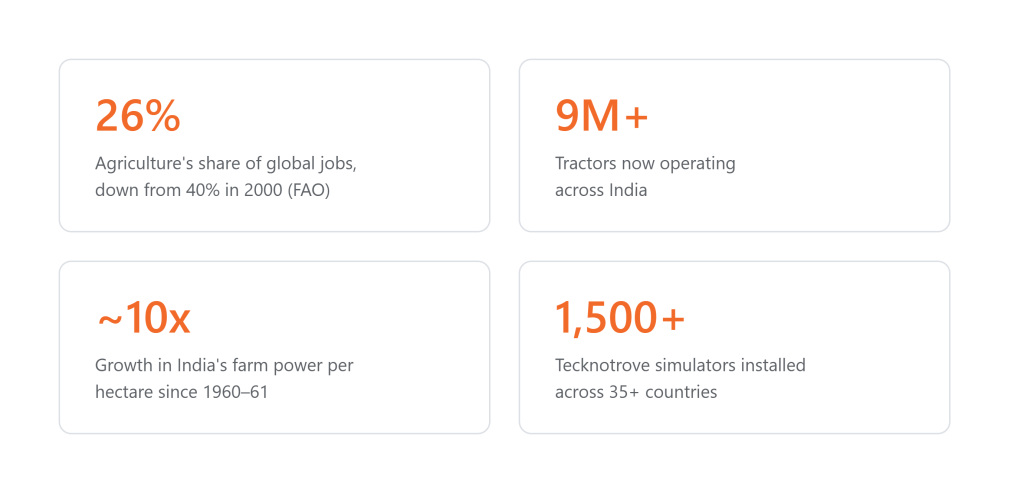
According to the Food and Agriculture Organization (FAO), agriculture's share of global employment has fallen from around 40% in 2000 to roughly 26% today. As fewer people work the land, mechanization is becoming essential to sustaining agricultural output. This shift has also created a growing need for a workforce capable of safely and efficiently operating increasingly sophisticated agricultural equipment.
As a result, workforce readiness has become just as important as machinery acquisition. Organizations are now looking beyond conventional operator training towards more scalable, standardized, and cost-effective approaches.
Simulation technology is emerging as one of the most practical training solutions to solve skill shortage in Agricultural Industry.
By enabling operators to learn, practice, and make mistakes within realistic virtual environments before entering live equipment, simulation helps organizations improve training outcomes while reducing operational costs and minimizing risk. Rising labour costs, larger farm sizes, and the increasing adoption of precision agriculture technologies are making skilled equipment operators a strategic asset rather than simply an operational requirement.
Why Is Traditional Agricultural Training No Longer Enough
Traditional live-machine training is struggling because equipment has become too expensive to learn on, seasonal windows too narrow to train in, and the skills required too technical for trial-and-error, while the experienced operators who once passed knowledge down are retiring faster than replacements arrive.
Equipment cost and complexity have shot up. A modern combine harvester or precision-guided tractor can run into the tens of lakhs to crores, loaded with GPS auto-steer, variable-rate application systems, and digital dashboards that look nothing like equipment from even ten years ago. Farmers and operators can’t afford to learn these systems by trial and error on a live machine.
Seasonal windows are unforgiving. Farming has narrow planting and harvesting windows — you can’t pull a tractor out of rotation for a week of trial-and-error training when the weather only gives you a few good field days. Simulators let training happen off-season, without eating into productive field time.
Labor shortage and generational turnover. Many regions are seeing older, experienced operators retire while new, less experienced workers step in — often without decades of hands-on farm exposure. Simulators compress that learning curve.
Safety on large, often solo-operated machinery. Tractors, harvesters, and sprayers cause a meaningful share of agricultural injuries rollovers, PTO entanglement, crush incidents. Practicing hazard response in a simulator removes that risk during the learning phase.
Precision agriculture skills are new and technical. Autonomous steering, drone-integrated spraying, data-driven field management — these are software skills layered onto mechanical ones, and classroom teaching alone doesn’t build the muscle memory operators need.
Multi-brand, multi-equipment fleets. Large farm operations and custom-hire operators often run equipment from several manufacturers; simulators let them cross-train operators across machines without needing every physical unit on-site.
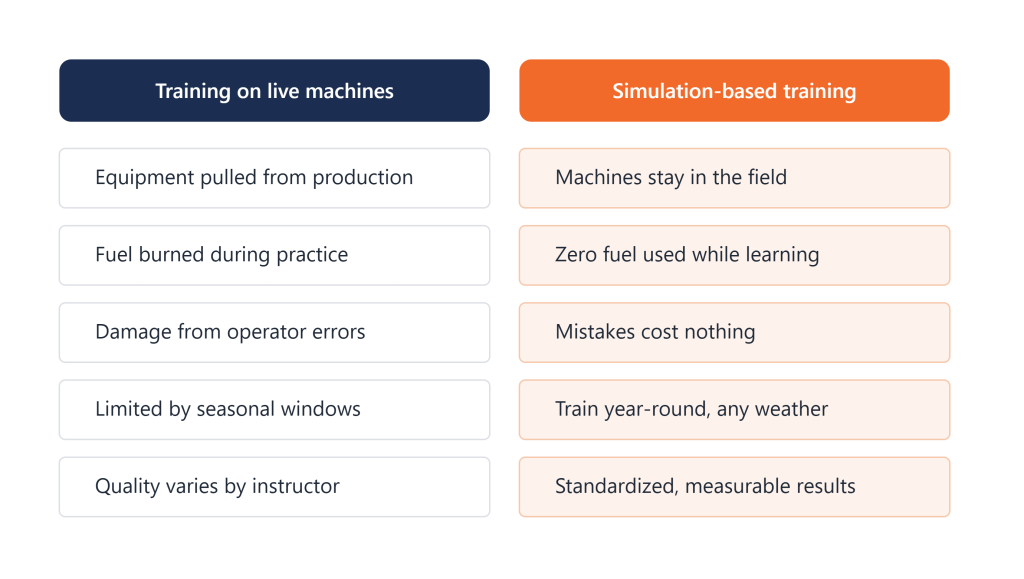
For decades, operator training has largely taken place using live machinery in real operating environments. While this approach provides hands-on experience, it also presents significant operational and financial challenges as agricultural equipment becomes more advanced and expensive.
Common challenge with traditional training include:
- High-value equipment being taken out of productive operations for training.
- Increased fuel consumption during operator familiarization.
- Higher maintenance costs caused by inexperienced machine handling.
- Equipment damage resulting from operator errors.
- Reduced productivity during seasonal farming operations.
- Inconsistent training quality across instructors and locations.
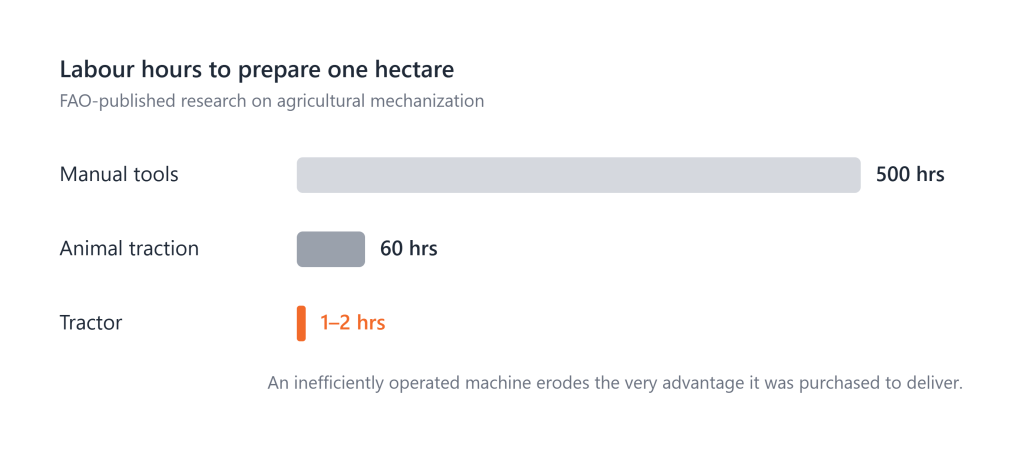
The productivity gains offered by mechanization also highlight why effective operator training matters. The productivity leap from mechanization is dramatic. FAO-published research shows that preparing one hectare of land requires roughly 500 labour hours using manual tools, around 60 hours with animal traction, and just one to two hours with a tractor. But capturing gains of this magnitude depends heavily on operator competency — an inefficiently operated machine erodes the very advantage it was purchased to deliver.
Simulation addresses this challenge by allowing operators to repeatedly practise both routine and high-risk scenarios without exposing equipment, crops, or personnel to unnecessary risk.
How Does Simulation Training Improve Workforce Readiness in Agriculture?
Modern agricultural simulators recreate real machine controls, operating environments, and field conditions within immersive virtual training systems.
Rather than replacing practical field experience, simulation prepares operators before they begin working with live machinery. This enables organizations to reduce the amount of basic familiarization required in the field while allowing instructors to focus on operational competence instead of introductory machine handling.
Simulation-based training enables organizations to:
- Train operators throughout the year regardless of seasonal farming schedules.
- Standardize operator training across multiple facilities and regions.
- Reduce dependence on production equipment for introductory training.
- Measure operator performance using objective assessment criteria.
- Safely recreate emergency and complex operating scenarios.
- Identify competency gaps before field deployment.
- Improve operator confidence through repeated practice.
Unlike traditional training methods, simulation also allows operators to repeat exercises until competency is achieved rather than progressing simply because equipment availability is limited.
This creates a more structured learning environment while improving overall training consistency across an organization.
How Are Government Agencies Using Simulators for Skill Development?
Governments around the world continue to invest in agricultural mechanization as a means of improving food security, increasing rural productivity, and addressing labour shortages. However, expanding access to machinery must be accompanied by investments in workforce capability.
The Food and Agriculture Organization (FAO) consistently emphasizes that skills and knowledge development are essential to sustainable agricultural mechanization. This principle is reflected in frameworks such as the FAO and African Union's Sustainable Agricultural Mechanization: A Framework for Africa, reinforcing that machinery alone cannot deliver long-term productivity gains without competent people operating it.
Simulation helps government agencies and public training centres:
- Deliver standardized operator training at scale.
- Measure competency using objective assessment criteria.
- Improve workforce readiness before field deployment.
- Support national mechanization and rural development initiatives.
- Maximize the utilization of publicly funded training infrastructure.
For organizations responsible for training hundreds or even thousands of operators annually, simulation offers a repeatable and scalable approach to workforce development.
How Do Simulators Help Vocational Training Institutes in Agriculture?
Educational institutions face increasing pressure to produce graduates who are ready to operate modern agricultural machinery from day one. However, providing practical training using live equipment is often constrained by equipment availability, operating costs, and safety considerations.
Simulation helps institutes:
- Modernize agricultural training programmes.
- Increase student training capacity.
- Deliver consistent practical instruction across multiple batches.
- Objectively assess student performance.
- Reduce dependence on live equipment for introductory training.
Students gain valuable practical experience before operating real machinery, improving confidence while helping institutions deliver industry-relevant education.
Why Is Simulation Becoming a Strategic Investment in Training?
The business case for simulation extends well beyond operator training.
As organizations invest more heavily in mechanization, protecting those investments becomes equally important. Well-trained operators contribute to improved equipment utilization, lower maintenance costs, safer operations, and greater operational consistency throughout the equipment lifecycle.
This is particularly relevant in markets such as India, where mechanization continues to accelerate: farm power availability has grown nearly tenfold over the past six decades (from 0.28 kW per hectare in 1960–61 to over 2.7 kW per hectare today) and tractor numbers have crossed nine million. Research across Indian agriculture consistently links mechanization to improved yields and incomes, while also showing that these benefits depend on effective adoption and utilization of equipment, making operator capability a central part of the overall investment.
The difference between conventional training and simulation-based training is becoming increasingly clear.
| Feature | Traditional Equipment Training | Simulation-Based Training |
|---|---|---|
| Hands-on practice with realistic controls | ✅ | ✅ |
| Trains without live equipment | ❌ | ✅ |
| Available year-round, in every season | ❌ | ✅ |
| Builds operator confidence | ✅ | ✅ |
| Saves fuel during training | ❌ | ✅ |
| Protects equipment from wear and tear | ❌ | ✅ |
| Develops practical machine-handling skills | ✅ | ✅ |
| Enables self-paced, standardized learning | ❌ | ✅ |
| Safely recreates difficult and emergency scenarios | ❌ | ✅ |
| Measures performance with objective analytics | ❌ | ✅ |
"For organizations seeking to improve workforce capability while maximizing equipment utilization, simulation is increasingly becoming a strategic investment rather than simply another training method."
— Shantanu Gupta
Why Organizations Choose Tecknotrove
Consider an agricultural contractor preparing for harvest season with 40 newly recruited operators. Traditionally, much of their initial learning would take place on production equipment, consuming fuel, occupying machinery, and increasing the likelihood of operating errors. With simulation, operators can complete their initial familiarization before entering the field, allowing production equipment to remain operational while instructors focus on refining operator competency.
Tecknotrove brings nearly two decades of experience training operators of complex, high-value machinery. With an installation base of more than 1,500 Tecknotrove simulators across 35+ countries, and heavy equipment simulators deployed for organizations such as Coal India, Tata Steel, and L&T, the same platform trusted in mining, construction, and aviation.
Tecknotrove solutions span multiple fidelity levels, from compact desktop trainers suited to institutes and large-batch training, to motion-platform simulators replicating real terrain and machine dynamics. Convertible kits let equipment types such as a tractor and wheel loader train on a single base unit, improving ROI for mixed fleets. Every Tecknotrove simulator includes an instructor station, real-time performance evaluation, session replay, and centralized trainee reporting, enabling objective assessment instead of subjective sign-offs, with multi-language training modules supporting self-paced learning at scale.
Preparing Agriculture for the Future
Agriculture is entering an era where technology, automation, and workforce capability must evolve together. While modern machinery continues to transform farming operations, its full potential can only be realized when operators have the knowledge and confidence to use it effectively.
Simulation technology addresses one of agriculture’s most pressing challenges by providing a safe, scalable, and standardized approach to workforce development. It enables organizations to build operator competency before equipment enters the field, reducing training-related risks while improving productivity and operational efficiency.
Whether supporting agricultural contractors, equipment manufacturers, dealer networks, government skill development programmes, vocational institutes, or large farming enterprises, simulation is helping reshape how agricultural operators are trained for the future.
As mechanization continues to advance, organizations that invest in both modern equipment and operator capability will be better positioned to improve productivity, protect high-value assets, and maximize the return on their technology investments.