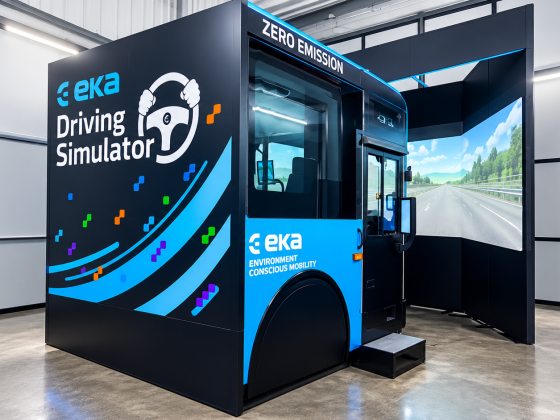
Walk into a modern DHL, FedEx, or Amazon facility and you’ll notice something about the way new forklift operators are trained: many of them never touch a real machine on day one. Instead, they climb into a simulator.
This isn’t a gimmick or a pilot project anymore. Simulator-based training for material handling equipment (MHE), including forklifts, reach trucks, order pickers and pallet movers, has quietly become the standard operating model for the world’s most sophisticated logistics networks. And the reasons behind that shift matter to every organization that puts an operator behind the controls of a lift truck, whether you run 40 distribution centers or a single training institute.
The Problem Every Warehouse Operator Knows Too Well
The logistics industry faces a structural challenge: it needs a continuous supply of skilled MHE operators, and it needs them work-ready from day one. High attrition, seasonal hiring surges, and rapid greenfield expansion mean training departments are under constant pressure to onboard faster without compromising safety.
Traditional training makes that difficult. Live-machine training requires a spare forklift, a blocked-off section of the warehouse, a dedicated instructor, and a tolerance for the occasional dinged rack or damaged pallet. It doesn’t scale; it can’t be standardized across sites, and every hour a trainee spends a real truck is an hour that truck isn’t moving freight.
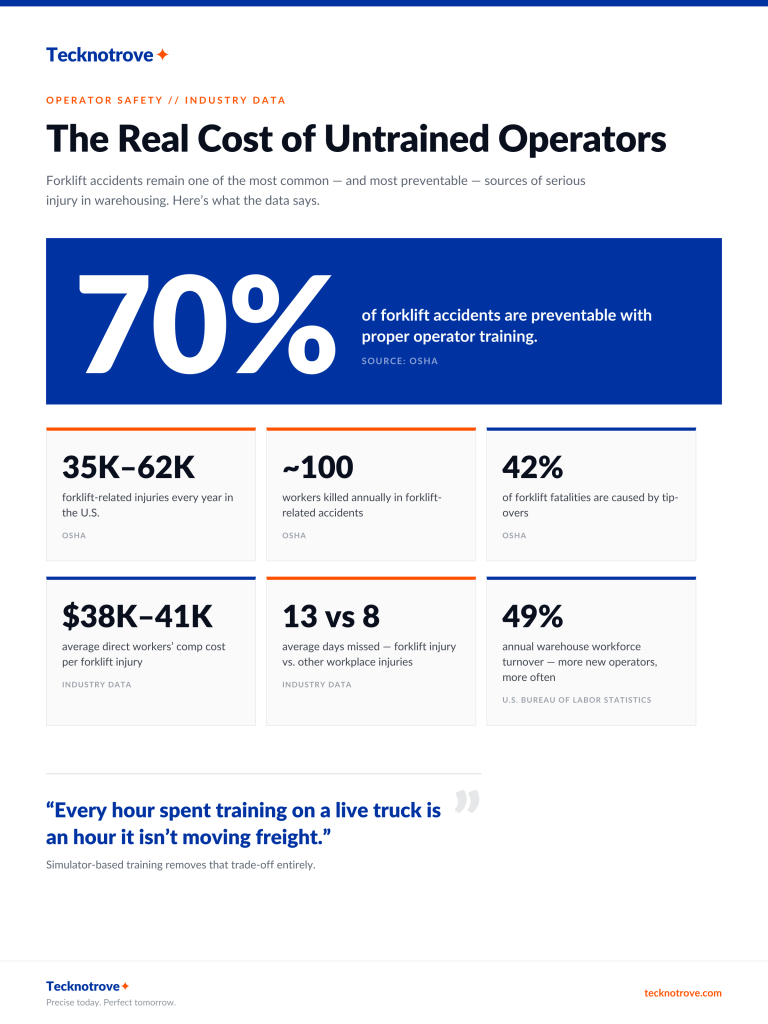
Meanwhile, forklifts accidents remain one of the most common sources of serious workplace incidents in warehousing. OSHA estimates between 35,000 and 62,000 forklift-related injuries every year in the United States alone, and roughly 100 workers are killed annually, with tip-overs accounting for around 42% of those fatalities. The cost side is just as stark: a single forklift injury runs $38,000–41,000 in direct workers’ compensation alone, and forklift-injured workers miss an average of 13 days of work versus 8 for other workplace injuries. Yet OSHA’s own analysis suggests around 70% of forklift accidents are preventable with proper training. Most incidents trace back to the same root causes poor load judgment, blind-spot errors, speed in tight aisles, pedestrian interaction which are precisely the skills hardest to teach safely on live equipment.
Layer on the labor math (US warehouse employment has grown more than 80% since 2010 on the back of e-commerce, while the sector runs annual turnover near 49% according to the Bureau of Labor Statistics) and the picture sharpens: warehouses must train more operators, more often, faster than ever, in an environment where undertrained operators are the single most expensive risk on the floor.
What the Industry Leaders Are Doing
The largest logistics and fulfillment companies saw this problem coming years ago, and their response has been remarkably consistent.
DHL began experimenting with VR-based training as far back as 2015 and now applies immersive training across sites on three continents. Its innovation team has publicly identified VR as ideal for operational health and safety training in logistics, precisely because content can be standardized and scaled globally, including scenarios like working safely around forklifts. The stakes are especially high in fast-growing markets like India, where DHL Supply Chain has doubled its warehousing footprint over the past five years to nearly 20 million square feet, the kind of expansion that makes standardized, scalable operator onboarding a necessity rather than a nice-to-have.
FedEx Ground, whose docks handle 8.5 million packages a day, partnered with a VR training provider to let new hires practice warehouse tasks and safety procedures in the classroom before they ever step onto a loading dock, with the company reporting a notable improvement in how much trainees retain.
Amazon has brought VR safety training into its fulfillment network, including immersive modules that teach associates how to safely enter and navigate robotics floors, which are hazardous, fast-moving environments that are nearly impossible to practice in safely any other way.
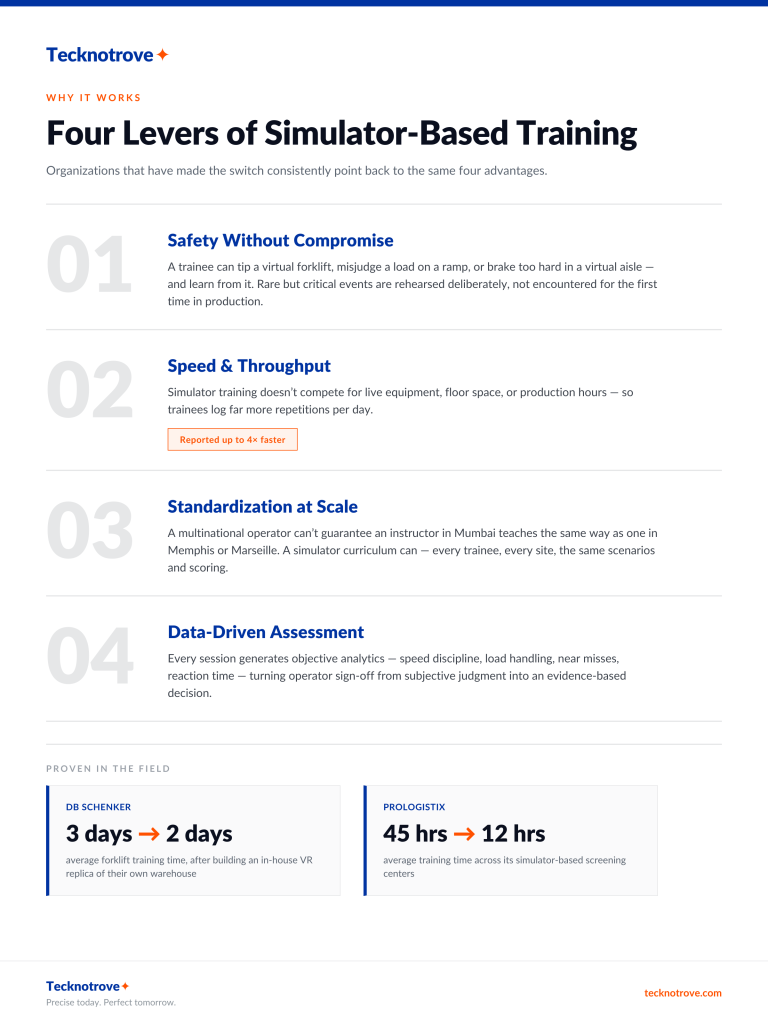
DB Schenker went as far as co-developing its own VR forklift training system for training operators in a virtual replica of their actual warehouse, cutting average forklift training time from three days to two.
Staffing and validation networks have gone the same way. ProLogistix, the warehouse staffing arm of Employbridge (one of North America’s largest industrial staffing agencies) runs 20 dedicated Training centers where simulator-based screening is used to assess and train thousands of forklift operators, with reported average training time falling from around 45 hours to as little as 12.
Just as telling is where this training now happens. Rather than sending operators to external schools, leading logistics networks are building training academies directly inside their largest multi-client sites and fulfillment hubs, while deploying mobile simulator units that travel to individual warehouses ahead of peak-season scaling. A portable simulator case shipped to a regional e-commerce hub before the holiday rush can turn a breakroom into a training academy for reach trucks and order pickers, exactly when throughput pressure makes pulling live equipment off the floor impossible.
The pattern across all of these programs is the same: simulators don’t replace certified instructors or real-machine assessment. They front-load the risky, repetitive, mistake-heavy phase of learning into a virtual environment, so that when a trainee finally operates a real forklift, they’re already past their most dangerous mistakes.
Material handling training simulators are making the Quiet Shift from Training Tool to Workforce Infrastructure
Here is what most coverage of this trend misses. The companies furthest along stopped thinking of simulators as training equipment some time ago. They treat them as workforce infrastructure: a layer of their operation that determines how fast they can hire, scale, and redeploy people.
Look at how the technology is actually being used. ProLogistix runs candidates through short simulator-based screening modules before hiring decisions are made. The simulator has become part of recruitment, not just onboarding. DHL’s mobile units travel to wherever peak-season scaling is about to happen. The simulator has become part of capacity planning. DB Schenker built its virtual environment as a replica of the actual warehouse. The simulator has become part of site operations, letting operators learn a new facility’s layout before the facility even goes live.
That reframes changes the investment logic entirely. A training tool is judged on cost per certified operator. Workforce infrastructure is judged on how quickly the operation can absorb a hiring surge, open a new site, cross-train operators across equipment classes, and prove, with data, that every person on a machine is competent to be there. By that standard, the simulator is one of the few capital purchases that pays off in safety, speed, and labor flexibility simultaneously. It’s also why the gap between organizations that use a simulator for training and those that don’t use simulators compounds every peak season.
Why Simulator-Based Forklift Operator Training Works: The Four Levers
Organizations that have made the switch consistently point to four advantages.
| Training Factor | Traditional Live-Machine Training | Simulator-Based Training |
|---|---|---|
| Practice volume | Limited by equipment, instructor, and floor availability | Unlimited repetitions, self-paced |
| Risky scenarios | Too dangerous to rehearse (tip-overs, pedestrian conflicts, equipment failure) | Rehearsed deliberately and repeatedly |
| Business impact during training | Ties up a working forklift and floor space | Zero impact on live operations |
| Consistency across sites | Depends on the individual instructor | Identical curriculum and scoring everywhere |
| Assessment | Subjective instructor sign-off | Objective performance data on every session |
| Onboarding bottleneck at peak season | Worst exactly when hiring surges | Scales with extra seats, not extra trucks |
- Safety without compromise. A simulator lets a trainee tip a virtual forklift, misjudge a virtual load on a ramp, or brake too hard in a virtual aisle, and learn from it. Rare but critical events, like a sudden equipment failure or a pedestrian stepping out from behind racking, can be rehearsed deliberately rather than encountered for the first time in production.
- Speed and throughput. Because simulator training doesn’t compete for live equipment, floor space, or production hours, trainees can log far more practice repetitions per day. Simulator providers and their customers report training up to four times faster, and documented programs like DB Schenker’s and ProLogistix’s show training timelines compressed by a third or more, a decisive advantage when onboarding seasonal workforces.
- Standardization at scale. A multinational 3PL cannot guarantee that an instructor in Mumbai teaches the same way as one in Memphis or Marseille. A simulator curriculum can. Every trainee, at every site, faces the same scenarios, the same hazards, and the same objective scoring criteria.
- Data-driven assessment. Modern simulators don’t just train; they measure. Instructors get objective analytics on every session, including speed discipline, load handling, near misses and reaction times, turning operator assessment from a subjective sign-off into an evidence-based decision. For screening new hires or re-certifying experienced operators, that data trail is invaluable.
What to Look For in an MHE Training Simulator
Not all simulators are created equal, and buyers’ evaluating options, whether for a corporate training academy or an independent institute, should weigh a few things carefully.
Fidelity of machine dynamics – The training value of a simulator depends on how honestly it replicates real equipment behavior: instability during tight turns with a raised load, braking distances under load, behavior on gradients and ramps. Advanced simulators, such as those developed by simulation specialists like Tecknotrove, are built as precise replicas of actual forklift equipment, with real seat dimensions, authentic controls, accurate steering response and lifting mechanisms, so that skills transfer directly to the warehouse floor.
Customizable virtual environments – Generic warehouse scenes are a start, but the strongest programs train operators in a digital twin of their own facility, including the actual aisle widths, loading bays, staging areas, ramps, and pedestrian routes they’ll work in. Leading providers can build custom virtual sites replicating a client’s specific warehouse or plant, complete with AI-driven pedestrian and vehicle traffic to rehearse both normal and high-risk conditions.
Flexible formats for different budgets and footprints – Full-motion replica simulators deliver the highest fidelity for corporate training centers, while desktop and VR-headset configurations make simulation viable for smaller institutes, mobile training units, and multi-station classrooms where a large group needs to train in parallel. The right vendor should offer a pathway across all of these, not force a one-size-fits-all purchase.
Built-in assessment and analytics – Look for structured training modules that progress from pre-operation checks and load balancing through to narrow-aisle work and emergency scenarios, with performance tracking that lets instructors give targeted feedback and identify who is genuinely floor-ready.
Alignment with regulatory and safety frameworks – Corporate training programs don’t operate in a vacuum. Global operators routinely benchmark their internal MHE curricula against bodies like the National Safety Council in the US and the National Safety Council of India, and against regulations ranging from OSHA standards to India’s Factories Act and DGMS requirements. A simulator curriculum should map cleanly onto the compliance framework of the region it’s deployed in, including local-language training modules and virtual environments that reflect local warehouse design, traffic patterns, and regulatory signage — rather than importing a generic curriculum built for a different regulatory world.
Simulation training is not just for the big players
Perhaps the most important shift in the last three years is that simulation has stopped being an enterprise-only technology.
Training institutes are adopting it to differentiate their programs and raise placement outcomes. Eversafe Academy in Singapore, an established workforce training provider, invested in advanced forklift training simulators from Tecknotrove to strengthen its workplace safety and skill development programs. Similarly the Higher Colleges of Technology in Dubai deployed a desktop VR forklift simulator that can be moved between locations on campus, giving students immersive, 360-degree operational practice with built-in performance analytics, without exposing them to the hazards of heavy machinery during the learning phase.
For smaller training centers, the economics have changed decisively. A forklift simulator now costs much lower than what a dedicated training forklift, insurance, fuel, maintenance, and training-yard space would, and it never needs downtime between batches. For institutes competing for corporate training contracts, offering simulator-based certification with objective performance reports is increasingly what wins the business, because it’s what corporate safety teams have come to expect.
India’s MHE Training Landscape Is Already Moving This Way
India offers a clear preview of where this is headed, because its MHE training ecosystem has matured fast alongside the country’s warehousing boom. A tier of specialized safety academies has emerged specifically to serve MNCs, 3PL operators, and auto OEMs that need training benchmarked against international standards.
Forklift Academy of India, based in Pune, runs corporate activity-based safety training, facility safety audits, and certified operator placement programs, with a particular focus on preventing rack collisions and tip-overs, the same failure modes that dominate the global accident data. RTITB India, the Indian accredited partner of the UK’s RTITB (a body with more than 60 years in transport and logistics training) delivers internationally recognized MHE operator certification across counterbalance forklifts, reach trucks, and stacker trucks, and has trained operators for supply chain teams at companies including Amazon and Flipkart.
The Road Safety Foundation, running dedicated forklift training centers in Bhiwandi, Panvel, and Faridabad, has trained tens of thousands of MHE operators for corporate clients including Tata Steel, JSW Steel, and Hindustan Unilever, with particular emphasis on high-reach truck handling and defensive driving at extreme racking heights.
Alongside this premium tier sits a much larger government-backed vocational system. The Logistics Sector Skill Council, working under India’s National Skill Development Corporation, maintains the official “Forklift Operator/Driver” National Occupational Standard (Qualification Pack ASC/Q9707) that underpins Skill India-recognized certification nationwide, the benchmark that vocational training providers across the country build their forklift courses against.
A third layer of regional, privately run technical institutes fills in the gaps between the two, often specializing by local industry. Rashtriya Technical Institute runs forklift operator courses across a wide network of cities spanning Maharashtra, Punjab, West Bengal, and Jharkhand, combining hands-on machine time with placement support. Krishna Technical Training Centre, based in the mining belt of Dhanbad, Jharkhand, trains forklift operators alongside heavy earthmoving equipment, including dozers, excavators and mobile cranes, reflecting the industrial and mining-adjacent demand of the region. HAM Institute and Services, based in Taliparamba, Kannur, Kerala, pairs forklift and mobile crane certification with placement pipelines that include Gulf employers, serving Kerala’s large workforce migrating to Middle East industrial and construction roles.
These institutes represent exactly the kind of organization for whom the economics of simulation make the strongest case: every training hour currently spent burning diesel, occupying yard space, and exposing a green operator to a loaded reach truck at height is a cost that a simulator curriculum removes, while adding the standardized, auditable, data-backed certification that global clients (and government skill frameworks alike) increasingly expect from their training partners.
The Bottom Line
The world’s leading logistics companies didn’t move MHE training to simulators because it was fashionable. They did it because the math works: fewer incidents, faster onboarding, standardized skills across sites, and objective data on every operator. As e-commerce volumes grow and experienced operators become harder to find, that math applies just as forcefully to mid-sized 3PLs, manufacturers, and training institutes as it does to global parcel networks.
The organizations pulling ahead are the ones that made the mental shift first: the simulator isn’t a piece of training equipment; it’s workforce infrastructure. Treat operator readiness as a strategic capability rather than a compliance checkbox, and safer, faster warehouses follow.